GLS Performance Motorsports LLC
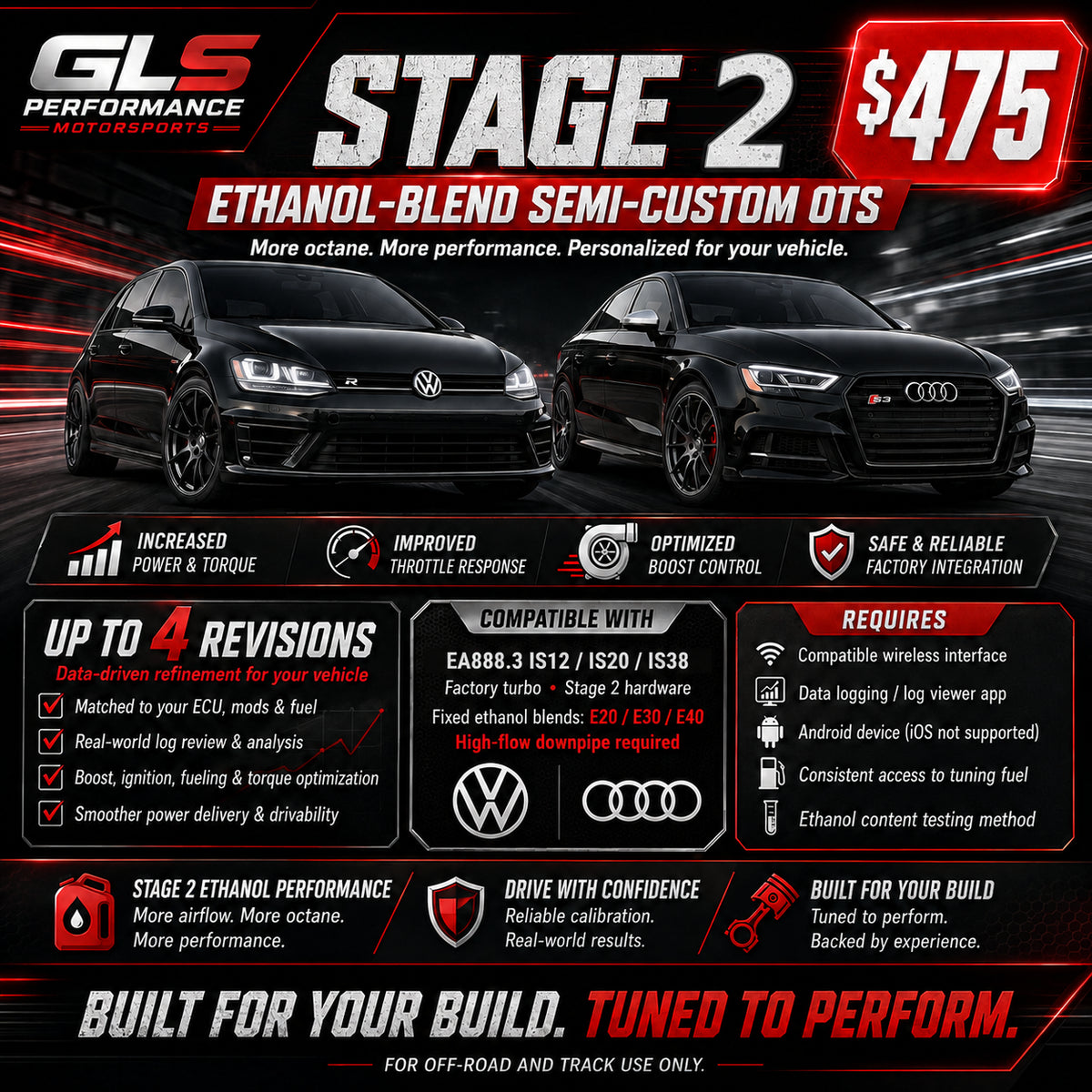
EA888.3 Stage 2 Ethanol-Blend Semi-Custom OTS ECU Tune
EA888.3 Stage 2 Ethanol-Blend Semi-Custom OTS ECU Tune
Couldn't load pickup availability
EA888.3 Stage 2 Ethanol-Blend Semi-Custom OTS ECU Tune
More Airflow. More Octane. More Performance.
Take your factory-turbo Volkswagen or Audi to the next level with a Stage 2 ethanol-blend semi-custom OTS ECU tune from GLS Performance Motorsports.
This calibration is designed for supported EA888.3 vehicles equipped with Stage 2 supporting hardware and operating on a specific ethanol blend. It combines the proven foundation of an off-the-shelf calibration with vehicle-specific data-log review and up to four calibration revisions.
Rather than receiving the same generic Stage 2 file used on every vehicle, your calibration is matched to your ECU software, factory turbocharger, transmission, modifications, base fuel, and approved ethanol concentration.
The result is stronger acceleration, improved turbo response, optimized ignition performance, and more consistent power delivery tailored to the way your vehicle is actually configured.
Designed for Stage 2 Ethanol-Blend Applications
This service is intended for vehicles retaining a factory IS12, IS20, or IS38 turbocharger and equipped with the appropriate Stage 2 supporting hardware.
Using an approved ethanol blend can provide increased effective octane and improved knock resistance compared with standard pump gasoline. When supported by the vehicle’s fuel system, this allows the calibration to make more effective use of the available turbocharger and airflow.
Depending on the vehicle and configuration, calibration refinement may include:
-
Boost and engine-load targeting
-
Factory electronic wastegate control
-
Ignition timing optimization
-
Lambda and fueling strategy
-
High-pressure and low-pressure fuel control
-
Torque delivery and management
-
Throttle-response optimization
-
Turbo spool and transient response
-
Boost-by-gear
-
Knock-control evaluation
-
Intake and exhaust camshaft strategy
-
Temperature and component protection
-
ECU and transmission torque coordination
-
High-RPM airflow and power delivery
The objective is not simply to command more boost. It is to create a complete Stage 2 calibration that uses the increased airflow and available fuel quality effectively.
Semi-Custom Calibration with Up to Four Revisions
Your tune begins with a proven Stage 2 ethanol-blend base calibration matched to your vehicle and ECU software.
After the initial calibration is installed, requested data logs are reviewed to evaluate how your vehicle is responding. When necessary, revisions are made to refine boost control, ignition behavior, fueling, torque delivery, and overall drivability.
This service includes up to four data-driven calibration revisions.
Areas reviewed may include:
-
Requested versus actual boost
-
Wastegate position and control
-
Engine load and airflow
-
Ignition timing and correction
-
Lambda and fuel trims
-
High-pressure fuel performance
-
Low-pressure fuel performance
-
Throttle closure
-
Torque intervention
-
Intake-air temperature
-
Ethanol-blend fueling demand
-
Knock activity
-
Turbo response
-
Overall power delivery
Not every vehicle will require all four revisions. Once the calibration is operating properly and meeting the agreed Stage 2 goals, the tuning process is considered complete.
Included revisions apply only to the vehicle, hardware, transmission, fuel grade, and ethanol concentration originally submitted with the order.
More Than a Generic Stage 2 Tune
Traditional off-the-shelf calibrations are designed to operate across a wide range of vehicles, climates, fuel quality, and hardware combinations.
Our semi-custom process adds an important level of refinement by reviewing real operating data from your specific vehicle.
This allows the calibration to be evaluated around:
-
Your exact ECU software
-
Your factory turbocharger
-
Your installed Stage 2 hardware
-
Your transmission
-
Your available base fuel
-
Your approved ethanol concentration
-
Your vehicle’s actual boost and wastegate behavior
-
Your fuel-system capability
-
Your ignition and knock-control response
You receive the convenience of a proven calibration foundation with the added confidence of vehicle-specific data review and refinement.
Supported Factory Turbo Applications
This service is intended for supported EA888.3 Volkswagen and Audi vehicles retaining one of the following factory turbochargers:
-
IS12
-
IS20
-
IS38
Hybrid, SRX, and full-frame turbocharger applications require the appropriate upgraded-turbo custom calibration service.
Typical Stage 2 Hardware
A compatible Stage 2 configuration may include:
-
Factory IS12, IS20, or IS38 turbocharger
-
Compatible high-flow downpipe
-
Stock or upgraded intake system
-
Upgraded turbo inlet
-
Upgraded intercooler
-
Upgraded charge piping
-
Stock or upgraded cat-back exhaust
-
DSG or manual transmission
-
Factory or approved upgraded fueling components
-
Properly functioning factory electronic wastegate system
An upgraded intercooler is strongly recommended, particularly in warmer climates or during repeated high-load operation.
Exact hardware requirements may vary by vehicle, turbocharger, fuel system, and intended ethanol concentration.
Fixed Ethanol-Blend Calibration
This calibration is designed for a specific, approved ethanol concentration or a narrow approved blend range.
Common examples may include:
-
E20
-
E30
-
E40
The appropriate blend will be determined after reviewing the vehicle, turbocharger, fuel system, base fuel, and performance goals.
This product is not a true flex-fuel calibration.
The vehicle must be operated using the approved ethanol blend whenever this calibration is installed or selected. Do not operate the vehicle on straight pump gasoline, full E85, or a substantially different ethanol concentration unless a separate compatible calibration is installed.
True flex-fuel operation requires the appropriate ethanol-content sensor, ECU integration, and dedicated flex-fuel calibration service.
Ethanol Testing and Mixing Requirements
Fuel sold as E85 does not always contain the same percentage of ethanol. Actual ethanol content can vary by season, location, and fuel supplier.
The customer is responsible for accurately testing and preparing the approved fuel blend.
You will need:
-
A reliable ethanol-content testing method
-
A known quantity of base gasoline
-
A known quantity of ethanol fuel
-
Accurate blend calculations
-
Consistent access to the fuel used during tuning
-
A fully mixed tank before collecting data logs
An ethanol-content test kit or compatible electronic ethanol-content measuring device is strongly recommended.
Data logs should not be collected until the blend is fully mixed and the vehicle has been driven long enough for the new fuel concentration to reach the engine.
Incorrectly measured or inconsistent fuel can result in inaccurate data, poor performance, fuel-pressure limitations, excessive correction, or unsafe operating conditions.
Fully Integrated ECU-Controlled Boost
Boost remains fully managed through the factory ECU and electronic wastegate system.
This allows boost control to operate as part of the complete engine-management strategy, coordinating with engine load, torque control, ignition timing, fueling, throttle position, gear selection, fuel pressure, and temperature protection.
Depending on the application, refinement may include:
-
RPM-based boost targeting
-
Wastegate pre-control
-
Closed-loop boost correction
-
Improved spool and transient response
-
Refined part-throttle boost behavior
-
Torque-based boost management
-
Boost-by-gear
-
Temperature-based protection
-
Fuel-pressure-based protection
-
Overboost protection
-
Controlled torque delivery in lower gears
The goal is controlled, repeatable performance—not simply the highest possible boost number.
Performance You Can Feel
Depending on the vehicle, turbocharger, ethanol concentration, base-fuel quality, transmission, and supporting hardware, the calibration may provide:
-
Increased horsepower and torque
-
Stronger midrange acceleration
-
Improved top-end performance
-
Sharper throttle response
-
Faster turbo response
-
More consistent ignition performance
-
Improved knock resistance compared with lower-octane fuel
-
More consistent boost delivery
-
Smoother and more predictable power
-
Improved ECU and transmission coordination
-
Better use of the installed Stage 2 hardware
Final performance will vary based on mechanical condition, fuel quality, actual ethanol content, environmental conditions, transmission, and supporting modifications.
No specific horsepower or torque output is guaranteed.
What’s Included
Your Stage 2 ethanol-blend semi-custom tuning service includes:
-
Proven Stage 2 ethanol-blend base calibration
-
Calibration matched to your ECU software
-
Vehicle and hardware compatibility review
-
Calibration matched to the approved ethanol concentration
-
Initial data-log review
-
Up to four calibration revisions
-
Boost, ignition, fueling, and torque refinement
-
Factory ECU-controlled boost management
-
Technical support throughout the revision process
-
Final calibration review
Multi-map switching, rolling anti-lag, true flex fuel, and other specialized features are not included unless specifically stated or purchased separately.
How the Tuning Process Works
1. Submit Your Vehicle Information
Provide the vehicle year, make, model, ECU information, transmission, complete modification list, factory turbocharger, fuel-system configuration, available base fuel, and performance goals.
2. Hardware and Fuel Review
Your setup will be reviewed to confirm that it is appropriate for the Stage 2 ethanol-blend semi-custom service.
3. Determine the Approved Blend
An appropriate ethanol concentration will be selected based on the vehicle, fuel system, turbocharger, base fuel, and intended performance level.
4. Prepare the Fuel
Test the ethanol fuel, calculate the required mixture, and prepare the approved blend before installing the calibration.
5. Receive the Initial Calibration
A proven Stage 2 ethanol-blend base file will be selected and configured for your vehicle and ECU software.
6. Flash and Data Log
Install the calibration and collect the requested data logs using a supported wireless interface and Android logging application.
7. Log Review and Revisions
Submitted logs will be reviewed for boost control, ignition behavior, fueling, fuel pressure, torque intervention, throttle operation, and other critical parameters.
Revised files will be supplied when necessary. The service includes up to four revisions.
8. Final Calibration Review
Once the vehicle is operating correctly and meeting the agreed Stage 2 ethanol-blend goals, the tuning process will be considered complete.
What You’ll Need
Remote tuning and data logging require:
-
A compatible wireless vehicle interface
-
A supported data-logging or log-viewer application
-
An Android phone or tablet
-
A reliable ethanol-content testing method
-
Consistent access to the selected gasoline and ethanol fuels
-
A safe and appropriate location for collecting requested logs
A dedicated budget Android phone or tablet may be used and connected through a mobile hotspot when necessary.
Apple and iOS devices are not currently supported.
Vehicle Condition Requirements
The vehicle must be mechanically sound before tuning begins.
Calibration revisions are intended to refine a properly functioning vehicle. They are not a substitute for mechanical diagnosis or repair.
The vehicle should be free from unresolved issues such as:
-
Boost or vacuum leaks
-
Exhaust leaks ahead of critical sensors
-
Faulty ignition coils
-
Worn or incorrectly gapped spark plugs
-
High-pressure or low-pressure fuel problems
-
Wastegate or turbocharger faults
-
Excessive knock activity
-
Cooling-system problems
-
Timing or camshaft faults
-
Transmission or clutch problems
-
Active engine-management faults
-
Incompatible or improperly installed hardware
Any mechanical or fuel-system problem discovered during data-log review must be corrected before the calibration process can continue.
Changes to Fuel or Hardware
The included revisions apply only to the original submitted configuration.
Changing any of the following may require a new or upgraded calibration service:
-
Ethanol concentration
-
Base gasoline octane
-
Downpipe
-
Turbocharger
-
High-pressure fuel pump
-
Low-pressure fuel pump
-
Port-injection system
-
Injectors
-
Intake manifold
-
Transmission
-
Major airflow hardware
All planned modifications should be completed before the tuning process begins.
GLS Performance Motorsports
Get the proven foundation of a Stage 2 calibration with the added octane, performance potential, and vehicle-specific refinement of an approved ethanol blend.
More airflow. More octane. More performance.
Built for your build. Tuned to perform.
This service is intended for supported factory-turbo Stage 2 vehicles operating on a specific approved ethanol blend. It is not a true flex-fuel calibration.
For off-road and track use only.
Share